

Six Crucial Take Aways From The Karnataka Elections That You Have Missed
The governor’s role is up for scrutiny as he is bound to call the coalition partners to stake claims
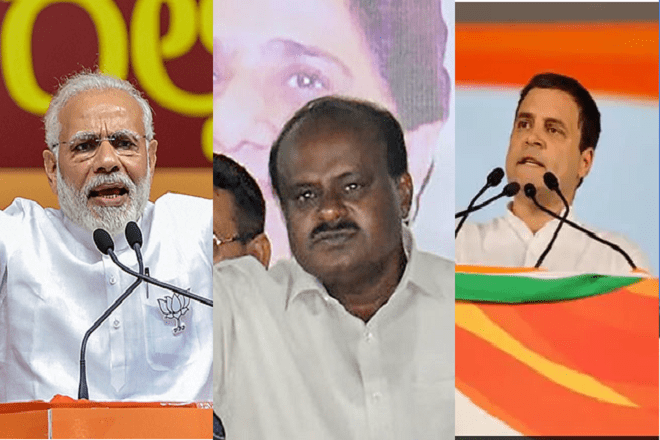
The Karnataka assembly elections produced a hung assembly on Tuesday with the Bharatiya Janata Party (BJP) emerging as the single largest party with 104 seats.
In the 222 seats where polls were held (election in two constituencies were deferred earlier), preliminary leads suggested that the BJP was on track to forming a government by securing a simple majority. BJP leaders rushed to the party headquarters and started distributing sweets. Some journalists and analysts started discussing how the verdict was a giant setback for Rahul Gandhi and a big thumbs-up for the Narendra Modi government at the Centre ahead of the 2019 general elections.
Around 2 pm, however, the situation took a dramatic turn. BJP supporters stopped the celebrations midway as the party’s tally dipped while that of the Congress and Janata Dal (Secular) [JD(S)] went up.
Some BJP leaders who were late in reaching the headquarters were even asked to return. The Congress reached out to JD(S) chief HD Deve Gowda and the two parties decided to form an alliance with the former PM’s son, Kumaraswamy, as the chief minister.
The BJP called a press conference and blamed Congress for trying to reverse the mandate and trying to sneak back into power through the back door.
They clearly forgot the precedents set in Meghalaya this year and Manipur and Goa last year when the BJP, despite not being the single largest party, successfully formed the government.
With the Congress-JD(S) coalition set to overcome the Modi-Shah challenge, here are the key takeaways from the Karnataka verdict this Tuesday evening:
1) Congress Won More Votes Than Any Other Party
According to the Election Commission of India, while 38 percent votes were polled for the Congress, BJP secured only 36.2 per cent of the votes. This translates to 13,68,1433 votes polled in Congress’s favour and the BJP getting 13,04,1755 votes. This itself should serve as a gentle reminder to not jump the gun for those who are dropping words like “moral issues” and “people’s choice” to back the BJP. Going by the number of votes alone, it is clear that Congress is the party of choice for the voters of Karnataka.
No Yeddyurappa Sir, mandate is not in BJP’s favour. In fact Congress got more votes than BJP & BJP didn’t get a majority. JDS & Cong have declared that they are willing for a coalition govt. Calling the BJP would be be disingenuous & would violate BJP’S own Goa/Manipur precedent https://t.co/HnXhGXK9N2
— Prashant Bhushan (@pbhushan1) May 15, 2018
2) The Chanakya & His Master- Shah & Modi Failed
It is surprising that this needs to be said but then again we live in a post-truth age. The so-called Modi-Magic failed. Chanakya could not get the BJP a sufficient majority. The famous strength of the cadre of the Rashtriya Swayamsevak Sangh (RSS) also failed to help the party cross the line. Sure they are the single largest party. They aren’t, however, going to form Government, but wait. Shah and Modi either succeeded in Goa and Manipur or they succeeded in Karnataka. In Manipur, the BJP won 21 seats and the Congress 28 in the 60-seat assembly but it was the BJP that eventually formed a government in alliance with other parties. Similarly, in the 40-strong Goa assembly, the BJP had won 13 seats and the Congress 17. And it was BJP again that managed to form an alliance. So depending on which side you lean, decide if the Shah-Modi magic hasn’t worked once, twice or thrice![/perfectpullquote]
1pm: Congress leading in voteshare, BJP in seats
Pundits: ‘Moral victory not enough if Rahul can’t defeat BJP’
5pm: Congress backs JDS to lead in voteshare & seats
Pundits: ‘Rahul can’t abandon morality just to defeat BJP’#KarnatakaElections2018— Raghu Karnad (@rkarnad) May 15, 2018
In 2008, when Shah and Modi were not in the picture, BJP won 110 seats, this time they are reduced to 104.
Despite the money, the inflammatory oratory, and a ground organisation, the BJP got just 36% of the vote compared to 41% in the 2014 Lok Sabha election. This is not a wave. It’s a party whose base is shrinking despite the seat number optics. The opp must prevent fragmentation.
— Anish Gupta (@anishguptauk) May 15, 2018
3) BJP & Above Caste Politics? Please
The BJP played its caste cards right and ended up victorious in the state’s coastal belt. Modi’s claims of keeping his politics above caste equations have died an early death, especially in light of the attempts made by BJP to communalise Mangalore, Bhatkal and neighbouring areas along caste lines.
4) BJP, Money & Corruption- Modi Taking A Shower Without A Raincoat On
An RTI reply has revealed that the Modi government has spent more than Rs 4000 crore on advertisements in the last 46 months. During the Karnataka elections, readers of newspapers in the state were greeted with front-page ads every day. The party spent a huge amount of money on advertising. Where is this money coming from? So much money in a party led by a man who likes to claim he is a fakir? The BJP gave seven tickets to the Reddys of Bellary -perceived to be extremely corrupt. Many party insiders said the high command couldn’t ignore them because they brought money and muscle power to their fold. The success of the BJP in Karnataka- even in the seats they got was aided by corruption and money power.
5) Will The Governor Of The State Please Stand Up?
Quick flashback: The single largest party was not invited by the governor to form a government in Goa and Manipur in 2017 and in Meghalaya in 2018.
Finance Minister Arun Jaitley feels it is not the BJP, but the JD(S)-Congress post-poll alliance that should be invited by the governor to form a government in Karnataka. Surprised? Well, it is the finance minister’s old tweet that resurfaced on social media on Tuesday.
— Shivam Vij (@DilliDurAst) May 15, 2018
Sitaram Yechury and Tejaswi Yadav also tweeted:
Same ‘rules’ followed when state govts were formed in Goa, Manipur and Bihar recently, must be followed now. Sauce for the goose must be sauce for the gander! JD(S)-Congress are together, past the majority mark & must be called to form the govt and take the floor test #Karnataka
— Sitaram Yechury (@SitaramYechury) May 15, 2018
क्या बिहार में बीजेपी को बहुमत मिला था?
क्या बिहारियों ने बीजेपी को बहुत बुरी तरह नहीं हराया था?नीतीश जी की मदद से बिहार में बहुमत का चीरहरण और लोकतंत्र का जनाजा निकाल चोर दरवाज़े से सरकार में बैठ मलाई चाट रहे भाजपाई कर्नाटक के मामले में उच्चकोटि का प्रवचन किसे बाँट रहे है?
— Tejaswi yadav (@YadavTejaswi) May 15, 2018
According to the rules, Governor Vajubhai Vala should do two things, a senior advocate told The Wire:
1) In case the governor notes that the single largest party does not have a complete majority, which in this case is true, he/she is bound to invite the parties which come together as post-poll coalition partners with a complete majority.
2) There are precedents like Goa and Manipur which the governor can take into consideration. The governor also might ensure that horse-trading doesn’t take place.
Hence, if the governor invites BJP it will be an opportunity for them to indulge in horse-trading which goes against the spirit of the Constitution.
Notably, Vala had vacated his Rajkot II seat to allow Modi to contest and win his first Assembly election from Gujarat in 2001. In September 2014, he was appointed as Karnataka’s governor soon after the BJP came to power.
Vala was also the speaker of the Gujarat Legislative Assembly from 2012 to 2014 and the state BJP chief between 2005 and 2006.
6) No mention of the Gujarat-model or for that matter any model in any state being ruled by the BJP.
That the BJP is governing more than 20 states in the country did not seem to help the party showcase a practical “development model” for Karnataka. The BJP was, in fact, silent on the (non)achievements of its governments in other states and relied on the tried and tested advantages of running a campaign that polarises the electorate on caste and religious line.